
Published: November 11, 2026 | Updated: November 11, 2026
Small Business Financial Planning
Cash Flow Forecasting & Liquidity Management Guide
www.apexadvisorgroup.com
(813) 678-2400
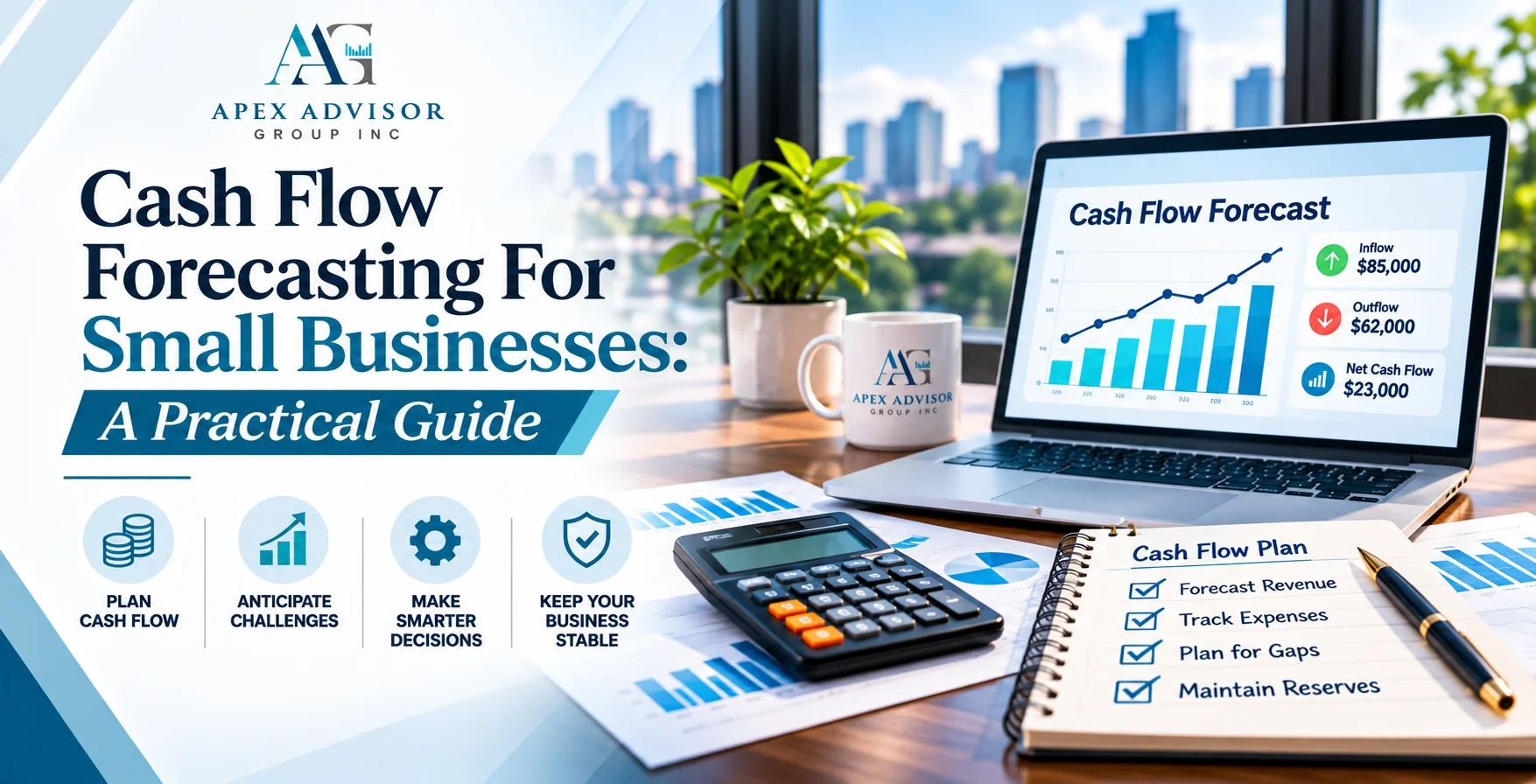
Cash Flow Forecasting For Small Businesses: A Practical Guide
Cash flow forecasting is the process of predicting the amount of cash that will flow into and out of a business over a given period. It's an early warning system for small businesses that helps them avoid liquidity crises, plan for capital expenditures and ensure they have enough cash flow to cover immediate obligations such as payroll and rent. A cash flow forecast does not deal with revenues and expenses as they are incurred, as an income statement does, but as actual cash is paid or received.
Key Takeaways
- Cash forecasting tracks money timing.
- Start with your actual available cash.
- Include every major expected inflow and outflow.
- Update your forecast regularly.
- Use realistic customer payment dates.
- It targets actual cash movements.
Standard short-term cash flow forecast horizon to answer urgent payroll and supplier coverage questions.
Surveyed small businesses that waited over 30 days for invoice payments in July 2026.
Small businesses using automated digital systems for bill payments according to July 2026 survey data.
What Is Cash Flow Forecasting For Small Businesses?
Small businesses estimate future cash outflows. Businesses use conservative scenarios for unexpected changes. It focuses on timing rather than accounting profit. You compare expected inflows against expected outflows for future periods. Your forecast usually covers several weeks or months. You can update it whenever new information arrives. This creates a clearer view of your available cash.
A simple forecast includes three core figures:
- Beginning cash balance
- Expected cash inflows
- Expected cash outflows
You then calculate your expected ending cash balance.
The basic formula is:
Ending Cash = Beginning Cash + Cash Inflows − Cash Outflows
This calculation looks simple. Precise timing enhances forecast value.
Why Does Cash Flow Forecasting Matter For Small Businesses?
Early detection prevents critical financial crises. It shows whether upcoming cash will cover upcoming obligations. You may have enough sales but insufficient cash. This can happen when customers pay late. It can also happen after large purchases or tax payments.
Research supports the importance of cash flow management. JPMorgan Chase Institute analyzed transaction data from over one million U.S. small businesses. It found that many businesses experienced irregular cash flows and limited liquidity.
Forecasting gives you time to respond. You could delay an optional purchase. You could follow up on unpaid invoices. You could adjust hiring plans. You could also arrange financing before cash becomes critical.
How Does A Cash Flow Forecast Work?
A cash flow forecast tracks expected cash movements by period. Most small businesses can start with weekly forecasts. Weekly forecasting works well when cash changes quickly. Monthly forecasting works well for longer-term planning.
Your forecast should include:
| Forecast Area | What You Track |
|---|---|
| Starting Cash | Cash available at the period start |
| Customer Payments | Expected money from customers |
| Other Income | Loans, refunds, or other receipts |
| Payroll | Wages, salaries, and related costs |
| Suppliers | Bills for products and services |
| Rent | Office, warehouse, or property payments |
| Taxes | Expected tax payments |
| Software | Recurring software subscriptions |
| Debt Payments | Loan and credit payments |
| Ending Cash | Expected remaining cash |
The goal is not a perfect prediction. The goal is better financial visibility.
How Do You Create A Cash Flow Forecast?
Creating a forecast becomes easier when you follow a fixed process. Start with your actual bank balance. Then estimate realistic future cash movements.
1. Start With Your Current Cash Balance
Use your actual available business cash. Check your bank accounts before building projections. Do not include expected payments yet. Only include cash already available. This gives you an accurate starting point.
2. List Your Expected Cash Inflows
Next, identify money your business expects to receive. Include customer payments and other predictable receipts. Use actual payment dates instead of invoice dates. A $10,000 invoice does not create $10,000 cash today. Your customer may pay in 30 days.
Consider:
- Open invoices
- Recurring customers
- Subscription revenue
- Contract payments
- Expected deposits
- Refunds
- Financing proceeds
Separate highly certain payments from uncertain ones.
3. List Your Expected Cash Outflows
Now record every expected cash payment. Include both recurring and irregular expenses. Large one-time expenses can change your forecast. Common expenses include payroll. Businesses pay rent. Businesses buy supplies. Businesses pay taxes. Businesses pay insurance. Businesses repay loans. Bank statements can reveal missed expenses. Recurring charges are especially easy to overlook.
4. Assign Realistic Payment Dates
Payment timing can matter more than total amounts. You expect $20,000 this month. Your bills require $15,000. You might assume your position is comfortable. However, your customers may pay near month-end. Your suppliers may require payment earlier. The timing could therefore create a temporary cash shortage.
5. Calculate Your Expected Ending Cash
Subtract expected outflows from expected inflows. Then add the beginning cash balance. Use the formula consistently each period. If your forecast shows negative cash, investigate immediately. Do not wait until the shortage occurs.
6. Update The Forecast Regularly
Frequent updates make forecasts more useful. Weekly updates suit businesses with changing cash positions. Monthly reviews support long-term planning. Actual results replace estimates after payments occur. Regular updates improve forecast accuracy.
Need Help Optimizing Your Business Cash Flow & Growth?
At Apex Advisor Group, we partner with growing businesses to streamline strategy and digital visibility.
REQUEST A STRATEGY SESSIONWhat Should You Include In A Small Business Cash Flow Forecast?
Your forecast should reflect your actual business model. Different businesses have different cash patterns. A service company may focus on invoice collections. Retailers may focus on inventory purchases. Contractors may track deposits. Contractors may track project milestones. Operating inflows include customer payments. They include deposits. They include subscriptions. Operating outflows include payroll. They include rent. They include supplies. Investing outflows include equipment. They include vehicles. Financing flows include loans. They include repayments. They include owner contributions. This structure gives you a more complete financial picture.
How Far Ahead Should You Forecast Cash Flow?
Most small businesses need short-term forecasts. They need long-term forecasts. Short forecasts detail immediate cash flows. Long forecasts guide future strategic planning. Companies leverage both tools. The 13-week forecast answers urgent questions. Can you cover payroll? Can you pay suppliers?
Annual forecasts direct major growth choices. They guide hiring choices. They guide expansion choices. Short forecasts assist cash-strapped businesses.
How Can You Improve Cash Flow Forecasting Accuracy?
Actual company figures enhance projection accuracy. Avoid optimistic sales estimates. Avoid optimistic collection estimates. Review past payment behavior. Check actual customer payment times. Invoice terms may allow 30 days. Customers may pay after 42 days.
Your forecast should reflect reality. You should also separate certain and uncertain cash flows. This makes risk easier to identify.
Consider three scenarios:
| Scenario | Assumption |
|---|---|
| Base Case | Most likely sales and payment timing |
| Conservative Case | Lower sales and slower collections |
| Growth Case | Higher sales and planned expansion |
Scenario analysis prepares various financial outcomes.
What Are The Most Common Cash Flow Forecasting Mistakes?
False assumptions create prediction errors. Businesses often focus on revenue. Businesses overlook actual cash timing.
Common mistakes include:
- Treating invoices as collected cash
- Ignoring annual or quarterly expenses
- Forgetting tax payments
- Underestimating seasonal changes
- Assuming every customer pays on time
- Excluding owner withdrawals
- Ignoring loan repayments
- Failing to update forecasts
Another mistake is confusing profit with cash. A profitable business can still experience cash shortages. This happens when cash arrives later than expenses become due.
How Can You Use Cash Flow Forecasting To Manage Late Payments?
Late customer payments can quickly damage cash flow. Your forecast can show which unpaid invoices create the greatest risk. Track invoice due dates carefully. Then compare those dates with expected payments.
QuickBooks reported a 59% rate. Surveyed small businesses waited over 30 days for invoice payments in July 2026. It also found that longer waits were associated with more reported cash flow problems.
You can reduce collection pressure by:
- Sending invoices promptly
- Offering clear payment terms
- Following up before due dates
- Offering convenient payment methods
- Reviewing overdue accounts weekly
- Requesting deposits for large projects
Your forecast should use expected collection dates.
How Much Cash Should A Small Business Keep?
There is no single cash reserve amount for every business. Your required buffer depends on expenses, revenue stability, debt, and industry.
JPMorgan Chase Institute research highlights the importance of cash buffers. Its research found major differences across small businesses and industries. It also linked stronger cash buffers with better business survival.
Instead of copying another company's reserve, calculate your own needs. Start by estimating essential daily cash outflows. Then consider how long revenue could realistically be disrupted. Businesses with irregular revenue may need larger buffers. Businesses with predictable collections may need less. Your forecast can help determine an appropriate target.
Illustrative Cash Movement & Buffer Analysis
What Does Advanced Cash Flow Forecasting Look Like?
Advanced forecasting combines historical data, current transactions, and multiple scenarios. It can also connect forecasts with accounting and payment systems. At this stage, you should track forecast accuracy. Compare projected cash against actual cash each period. Identify where your assumptions were wrong. For example, you may discover that customers consistently pay seven days late. You can then adjust future forecasts.
You can also track:
- Forecast variance
- Collection delays
- Expense volatility
- Seasonal patterns
- Cash buffer days
- Customer concentration
- Upcoming large payments
Proper methods refine corporate decision making.
How Can Technology Simplify Cash Flow Forecasting?
Modern software minimizes tedious manuals. Many platforms can connect transactions, invoices, bills, and payments.
Automation helps you maintain current information. However, automation does not guarantee accurate assumptions. You still need to review expected payment dates. You also need to consider unusual expenses and business changes.
Current QuickBooks research shows that digital payment and automation tools are widely used by small businesses. Its July 2026 survey found 73% used automated systems for bill payments.
What Should You Do When Your Forecast Shows A Cash Shortage?
Act before the shortage reaches your bank account. Start by identifying the timing and size of the gap. Then review possible actions. You could accelerate customer collections. You could postpone nonessential purchases. You could negotiate supplier payment terms. Companies reduce temporary operational spending. Persistent deficits require external financing options.
Borrowers calculate complete loan costs. The key is early action. A forecast gives you time to choose among available options.
Conclusion
Forecasting prevents financial surprises early. It converts unpredictable risks into actionable metrics. At Apex Advisor Group, we help businesses communicate clearly and grow their digital presence. We understand that strong business growth also requires organized planning.
We create content for your business goals. We build your online presence. We support consistent lead generation. If you want clearer business communication and better digital visibility, we are ready to help. Let’s build content that supports your next stage of growth.
Ready To Elevate Your Business Communication & Digital Visibility?
Connect with Apex Advisor Group today to create impactful content and scalable growth strategies.
CONTACT Apex Advisor GroupFAQS
What Is Cash Flow Forecasting For Small Businesses?
Cash forecasts estimate incoming revenue streams. It estimates future cash outflows. It shows available cash for upcoming weeks or months. You can therefore identify shortages before they affect operations.
Why Is Cash Flow Forecasting Important For Small Businesses?
Cash projections track payment timing. Sales produce delayed cash receipts. Forecasting checks expense coverage.
How Often Should A Small Business Update Its Cash Flow Forecast?
Small companies examine predictions weekly. Businesses with stable cash flow may review them monthly. Update estimates after major sales. Update estimates after major expenses. Update estimates after payment delays.
What Is The Difference Between Cash Flow And Profit?
Profit measures revenue against expenses. Cash flow measures actual money entering the business. Profitable businesses can still face temporary cash shortages.
How Many Months Should A Small Business Forecast?
Quarterly projections offer immediate visibility. Annual forecasts guide future choices. Both tools address current debts. Both tools inform strategic goals.
Can Small Businesses Forecast Cash Flow Without Accounting Software?
Yes, Spreadsheets build accurate cash projections. Users input initial balances. Managers track actual transaction data.
What Is A Cash Flow Buffer?
A cash flow buffer is money kept available for future needs. It can cover expenses during payment delays or unexpected disruptions. Your ideal buffer depends on your business risk.
Official Small Business Financial Resources & References
For additional small business financial management and cash flow planning guidance, explore the U.S. Small Business Administration (SBA) financial management guide and review IRS small business estimated tax guidelines to account for quarterly tax obligations in your cash flow projections.
Related Articles & Services
Learn more about best tips for small businesses to avoid penalty tax, discover top financial reporting tips for small businesses, or explore the benefits of outsourcing payroll for tax efficiency. You can also connect with our team for professional accounting and bookkeeping services and strategic tax planning.
Disclaimer
This blog is for informational purposes only. If you want to know anything in details, please contact Apex Advisor Group.