
June 7, 2026
Apex Advisor Group
Tax, Accounting & Financial Services | Tampa, FL
apexadvisorgroup.com
(813) 678-2400
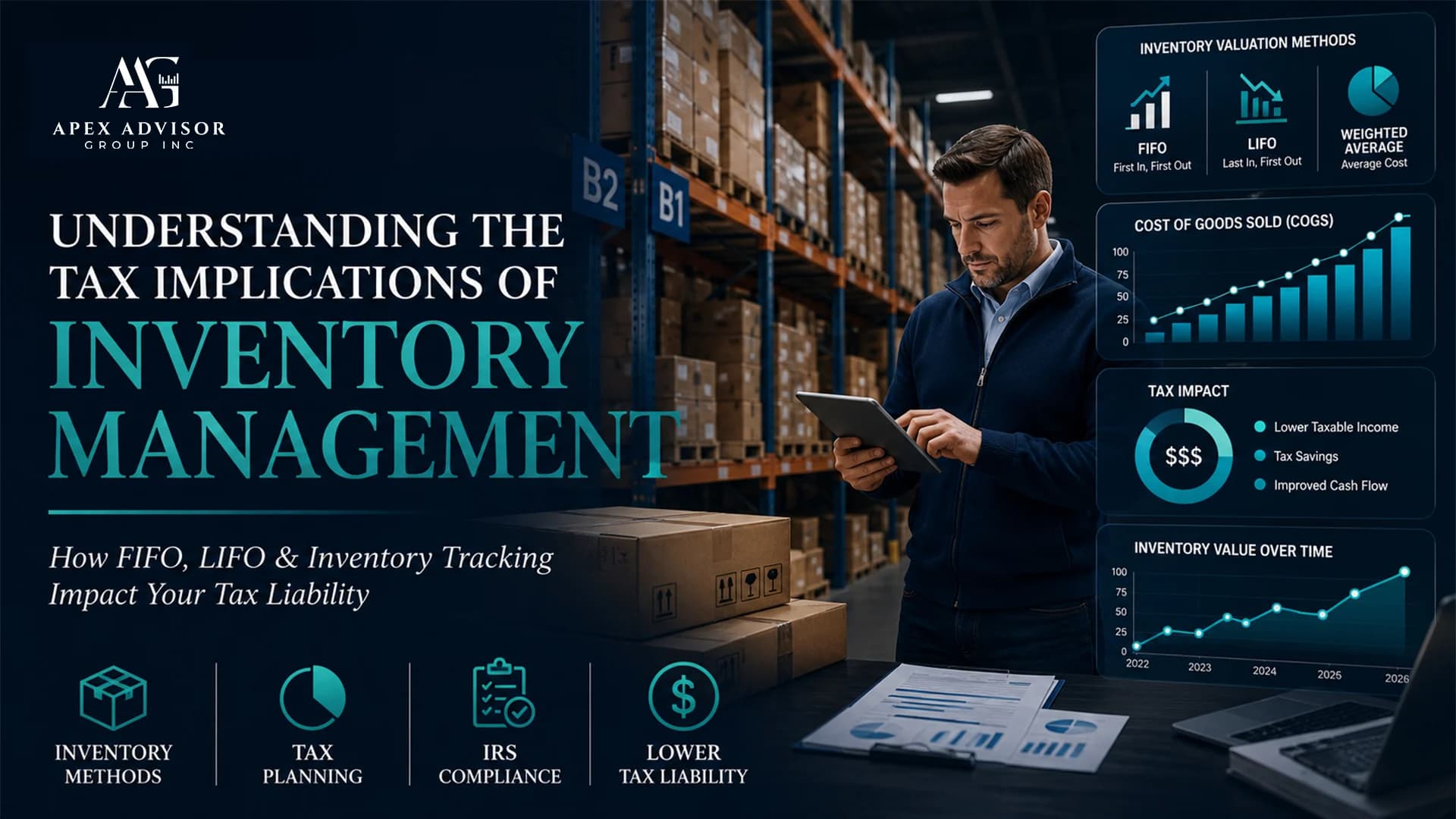
Understanding the tax implications of inventory management means knowing how your valuation method shapes taxable income. FIFO, LIFO, and weighted average cost each affect cost of goods sold differently. The right choice can legally reduce what your business owes every tax season.
Every item sitting in your warehouse carries a cost. Which cost the IRS sees depends on your chosen inventory accounting method, your recordkeeping, and how cleanly your year-end inventory count supports the return.
Key Points
Your inventory valuation method directly determines your cost of goods sold (COGS) and taxable income.
FIFO typically raises your tax bill during inflation by using older, lower-cost prices.
LIFO can lower taxable income by matching current, higher costs against revenue.
Businesses with under $32 million in average annual gross receipts can qualify for simplified IRS inventory rules in 2026.
Switching methods requires IRS approval through Form 3115 and a Section 481(a) adjustment.
Year-end physical counts, purchase invoices, and clean inventory records protect deductions and reduce audit risk.
How Does Your Inventory Valuation Method Affect Your Tax Bill?
Your inventory valuation method determines how you calculate COGS. COGS is subtracted from revenue to arrive at taxable income. A higher COGS usually means a lower tax bill. A lower COGS usually means the opposite.
Here is what many Florida business owners miss: two Tampa retailers can hold identical inventory and report the same total sales, yet leave tax season with very different liabilities. The only variable may be their chosen inventory method.
Apex Advisor Group Client Survey
of Tampa-area small business owners surveyed could not identify which inventory valuation method appeared in their financial statements.
The IRS Publication 538 inventory guidance discusses accepted inventory methods, including FIFO and LIFO, and explains why inventory value is a major factor in taxable income. At Apex Advisor Group, our accounting team in Tampa helps business owners close that gap legally and strategically.
FIFO vs. LIFO vs. Weighted Average Cost
| Method | What It Assumes | COGS in Inflation | Tax Impact | Best For |
|---|---|---|---|---|
| FIFO | Oldest items sold first | Lower | Higher tax | Perishables and growing businesses |
| LIFO | Newest items sold first | Higher | Lower tax | Inflation-heavy industries |
| Weighted Average | Average cost per unit applied | Moderate | Moderate | High-volume uniform goods |
1) FIFO: Older Costs, Higher Taxable Income in Inflation
FIFO assumes the oldest items you purchased are the first items sold. In a rising-price market, COGS reflects older, lower costs while ending inventory carries newer, higher prices.
That can make profits look stronger on paper, but it can also increase taxable income. For Tampa retailers, distributors, and e-commerce companies, the FIFO tax impact can become expensive when vendor prices climb quickly.
2) LIFO: Current Costs Against Current Revenue
LIFO flips the assumption. It treats the most recently purchased items as sold first. During inflation, that means COGS reflects current, higher replacement costs, and taxable income can drop.
That is the appeal of LIFO inventory accounting, especially when tariff-driven or supplier-driven cost increases are pushing product prices higher. The tradeoff is the LIFO conformity rule: if you use LIFO for tax, you generally need to use it on financial statements provided to shareholders, owners, or lenders.
An uninformed switch can create banking, reporting, and tax-planning problems. Apex Advisor Group can model the impact before a Florida business commits to the change.
3) Weighted Average Cost: Simpler and More Predictable
Weighted average cost applies one blended unit cost across inventory. It is often easier to administer and works well for high-volume businesses that sell uniform products across many transactions.
The tax result usually lands between FIFO and LIFO. It may not create the lowest possible taxable income, but it can produce steadier books and cleaner inventory reporting.
Why LIFO Is Getting Attention in 2026
A February 2026 analysis from The Tax Adviser notes that inflation and tariff-driven cost increases can make LIFO adoption more compelling. Businesses that use LIFO can often deduct inventory at current replacement cost, but they must also weigh LIFO recapture, reporting, lender expectations, and conformity rules.
Does Florida Have Any Special Inventory Tax Rules?
Florida does not collect personal income tax, but Florida businesses still file federal returns and pay federal income tax. Your inventory method directly affects that federal bill.
There is a second layer for many Tampa Bay companies. Hillsborough County and nearby counties assess tangible personal property tax on certain business assets. Accurate inventory tracking and asset records can support both federal COGS and county-level compliance.
2026 IRS Gross Receipts Threshold
Average annual gross receipts limit for smaller businesses that may use simplified inventory accounting rules under Section 471(c).
Tampa Bay Compliance Note
The Hillsborough County Property Appraiser offers online filing for tangible personal property returns, making clean asset and inventory records especially useful for local businesses.
Review IRS tax year 2026 inflation adjustment materials through Revenue Procedure 2025-32 and the local Hillsborough County tangible personal property resources before finalizing year-end inventory and asset records.
When Should a Florida Business Consider Switching Inventory Methods?
Switching inventory methods is a serious decision because the IRS treats it as a formal change in accounting method. It can create tax savings, but it can also create financial statement changes, lender questions, and a cumulative Section 481(a) adjustment.
Model the Method Change
Run your inventory and COGS under both methods for at least three prior years. Review taxable income, cash flow, lending covenants, and year-end inventory value before filing.
Prepare Form 3115
The IRS treats most inventory method changes as formal accounting method changes. Businesses generally file Form 3115 with the tax return and send a duplicate to the IRS National Office when required.
Calculate Section 481(a)
The Section 481(a) adjustment reconciles the cumulative income difference between the old and new methods so income is not duplicated or missed.
Plan the Tax Timing
A negative adjustment usually reduces income in the year of change. A positive adjustment generally spreads income over four years, which matters when moving away from LIFO.
Start with the IRS pages for Form 3115 and the Form 3115 instructions. For an additional plain-English explanation of Section 481(a), see LegalClarity's Section 481 adjustment guide.
How Can Proper Inventory Tracking Reduce Your Tax Liability?
Clean records are your strongest line of defense. Your documentation should include purchase invoices, production costs, physical count sheets, inventory adjustments, and the records supporting obsolete or damaged inventory write-downs.
Inventory that cannot be sold at normal prices may be written down to its lower market value under the lower of cost or market rule. That write-down can reduce taxable income when properly supported.
Purchase Invoices
Keep vendor bills, freight charges, discounts, and production costs organized so inventory cost is defensible.
Physical Count Sheets
A verified year-end count helps align your books with what is actually on the shelf, in storage, or in transit.
Inventory Adjustments
Document shrinkage, obsolete goods, damaged stock, and write-downs to support the lower of cost or market rule when it applies.
COGS Reconciliation
Reconcile beginning inventory, purchases, ending inventory, and COGS before tax season so errors do not flow into taxable income.
Tax Burden by Inventory Method in an Inflation Scenario
FIFO
High
Weighted Average
Moderate
LIFO
Low
Stop Guessing. Start Saving.
The Apex Advisor Group team in Tampa is ready to review your inventory method and uncover the tax savings you may be leaving on the table.
Contact Apex Advisor Group TodayFrequently Asked Questions
Q: Is inventory directly tax-deductible?
A: No. Inventory is generally deducted when sold through cost of goods sold on your federal return, not when it is simply purchased and still sitting in stock.
Q: What happens if my year-end inventory count is wrong?
A: It miscalculates COGS and taxable income. That can lead to overpaid tax, underpaid tax, penalties, interest, and avoidable IRS questions.
Q: Can I use a different inventory method for each product line?
A: Generally, the IRS expects a consistent inventory accounting method across the business operation unless a permitted method change or specialized rule applies.
Q: What qualifies a business for simplified inventory rules in 2026?
A: A business may qualify if average annual gross receipts are under $32 million over the three preceding tax years, subject to Section 471(c), Section 448(c), and related IRS rules.
Q: Is LIFO allowed under international accounting standards?
A: No. LIFO is permitted under U.S. GAAP, but it is not allowed under IFRS, which matters for businesses with international reporting needs.
Q: How do I formally elect the LIFO inventory method?
A: File IRS Form 970 with the tax return for the first year you want the LIFO method to take effect, and make sure the book-tax conformity rules are reviewed first.
IRS and Planning Resources
For official inventory and method-change guidance, review IRS Publication 538, IRS Form 3115, and IRS Form 970. These resources support inventory valuation, accounting method changes, and LIFO elections.
If your inventory issues are tied to online sales volume, review our service page for e-commerce bookkeeping services and the systems that keep tax records cleaner.
For broader year-round support, Apex Advisor Group also provides tax planning services for Tampa, Brandon, Riverview, Plant City, Wesley Chapel, and nearby Florida businesses.
Build a Smarter Inventory Tax Strategy
Visit Apex Advisor Group at 1211 Tech Blvd, Suite 120, Tampa, FL 33619, or call (813) 678-2400 to schedule an inventory management tax review.
Schedule a ConsultationDisclaimer: This article provides general information and does not establish a professional-client relationship. For specific assistance with your financial matters, contact Apex Advisor.