
June 14, 2026
Apex Advisor Group
Tampa's Tax & Accounting Experts
apexadvisorgroup.com
(813) 678-2400
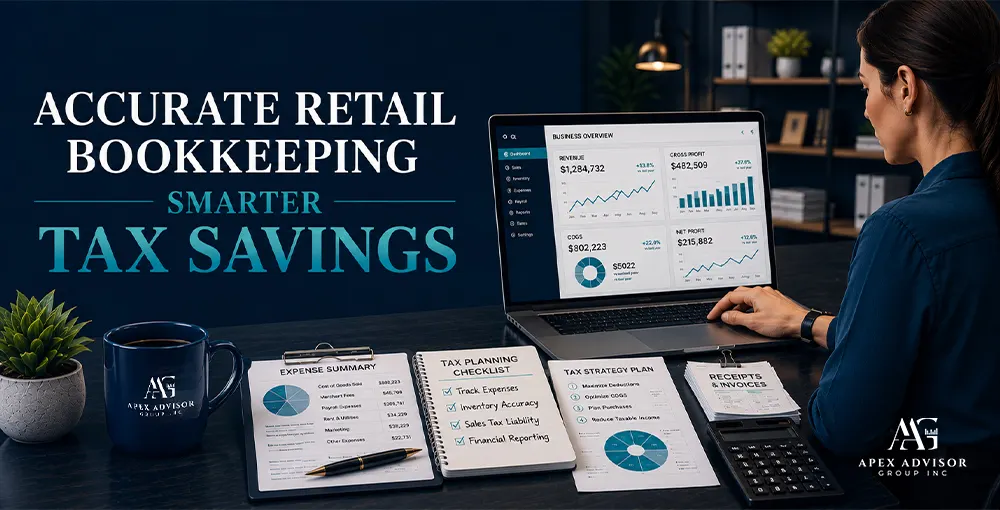
Accurate retail bookkeeping lowers your tax bill by proving deductions, preventing overpayment, and keeping you compliant. It also reduces audit risk, providing clean numbers for smart, legal tax planning.
Key Points
Track inventory consistently or COGS will be wrong
Record sales tax as a liability, not income
Keep owner spending separate from business spending
Use accurate monthly reports for tax planning decisions
What “Tax Efficiency” Means for Retail Businesses in Plain Terms
Tax efficiency means paying what you legally owe without extra payments. It avoids penalties and wasted time. For retail, tax efficiency often comes down to five key areas that generate the most bookkeeping errors:
- Expense tracking and categorization
- Accurate inventory accounting
- Sales tax management
- Payroll and contractor payments
- Timing of income and expenses
Clean Books Reduce Taxable Income by Capturing Deductions You Often Miss
You reduce taxable income by recording business expenses completely. You also reduce it by categorizing them correctly. Retail owners often miss small, frequent costs. These costs add up quickly. They also get misposted often, resulting in lost tax write-offs. Examples of commonly missed deductions include merchant processor fees, specialized packaging, damaged goods, bank charges, software subscriptions, and delivery/shipping costs.
What Accurate Categorization Does for You
Accurate categorization makes your tax return cleaner. It also helps you use the right tax forms and schedules, reducing the risk of “miscellaneous expense” bloat on your tax filings. This matters because vague categories raise questions and trigger reviews. Clear categories answer those questions before they get asked.
Don't let unorganized records cost you money. Contact Apex Advisor Group to clean up your records and plan taxes with confidence.
Accurate Inventory Accounting is the Biggest Retail Tax Lever
Inventory errors are one of the fastest ways to overpay taxes. Inventory valuation drives your Cost of Goods Sold (COGS), which in turn determines your taxable profit. If you understate COGS, you artificially overstate your profits, causing you to pay more income tax and self-employment tax than necessary. Conversely, overstating COGS to reduce taxes invites heavy audit pressure and distorts your true margins.
How Accurate Inventory Tracking Improves Tax Outcomes
Establishing an accurate inventory workflow enables your business to:
- Value inventory correctly at the end of each period
- Capture shrink, spoilage, and obsolescence write-downs properly
- Match inventory purchases to sales in the correct period
- Support COGS deductions with clean reports and physical counts
For a deeper dive into how different inventory valuation methods affect your tax liability, check out our guide on understanding the tax implications of inventory management.
Inventory Tracking Roadmap by Level
Beginner Level
Weekly Tracking
Track purchases, returns, and stock adjustments. Reconcile sales channels and save vendor invoices.
Intermediate Level
Monthly Tracking
Conduct cycle counts, reconcile the inventory system to the accounting books, and review gross margins by category.
Expert Level
Quarterly Tracking
Review valuation methods for consistency, adjust obsolete stock reserves, and audit shrink rates against history.
Sales Tax Errors are Expensive, and Bookkeeping is Your First Defense
Sales tax mistakes trigger notices and expensive penalties quickly. In modern retail, sales tax complexity has skyrocketed with omnichannel sales (in-store and online) across different state lines. Constant updates to economic nexus rules require reliable records to separate taxable and non-taxable transactions, and to separate collected sales tax from sales revenue.
What You Should See in Your Books for Sales Tax
A properly set up retail bookkeeping system should break down:
- Gross sales vs. Net sales
- Taxable vs. Non-taxable sales
- Sales tax collected as a liability on the balance sheet
- Marketplace facilitator tax handling (where tax is collected on your behalf)
If collected sales tax is mistakenly booked as income, your profit will look higher than it is, inflating your income tax and creating audit discrepancies with the Florida Department of Revenue.
Accurate Payroll Bookkeeping Protects Deductions and Reduces Payroll Tax Surprises
Wages and benefits are highly deductible, but only when tracked and reported correctly. Errors in hourly wages, overtime, or tips can trigger payroll audit penalties and require amended tax filings. Accurate payroll bookkeeping ensures that employer payroll taxes, health insurance matches, and retirement contributions are correctly recorded and match quarterly and annual tax returns (Forms 941 and W-2).
Bookkeeping Accuracy Helps You Choose the Right Tax Strategies at the Right Time
Tax planning strategies require reliable financial numbers. Without accurate books, you are simply guessing, which leads to missed opportunities. With accurate monthly reports, you can make intelligent, timely decisions regarding:
- Timing equipment and inventory purchases for optimal depreciation write-offs
- Structuring reasonable compensation for S Corp owners
- Calculating and making retirement plan contributions tied to net business profit
You cannot time expenses or forecast cash flow effectively without up-to-date monthly records.
Better Records Lower Audit Risk and Make Audits Less Painful
Accurate bookkeeping significantly reduces audit risks by keeping files consistent. Auditing bodies and tax agencies typically ask for bank statements, point-of-sale reports, receipts, payroll journals, and inventory counts. With organized books, you can resolve questions in hours rather than weeks, keeping your focus on running your business.
Accurate Retail Bookkeeping Improves Cash Flow, Which Indirectly Improves Tax Efficiency
Healthy cash flow is critical for execution. It allows you to pay your tax liabilities on time, avoiding high penalties and interest charges. It also ensures you have cash available to invest in deductions when the timing is most strategic. Accurate books also help you identify and stop cash leaks like under-tracked merchant processor fees or un-reconciled bank discrepancies.
Original Data: Common Tax-Costing Bookkeeping Mistakes
To highlight how common these errors are, our team at Apex Advisor Group conducted an internal review of 48 new retail onboarding files and prior-year tax summaries in May 2026. The results reflect our internal observations across onboarding files (n=48 retail businesses; not a public study) and track key issues that negatively impact retail tax efficiency.
| Issue Found During Review | Share of Businesses (n=48) | Typical Tax Impact | Why It Happens |
|---|---|---|---|
| Sales tax recorded as income | 29% | Overstated revenue and profit | Improper chart of accounts setup |
| Inventory purchases expensed incorrectly | 46% | COGS distortion across years | No inventory workflow or counts |
| Owner spending mixed with business | 54% | Missed deductions and audit risk | No separate accounts or rules |
| Missing merchant fee tracking | 41% | Understated expenses | Deposits booked net without detail |
| Unreconciled bank accounts monthly | 63% | Inaccurate income and expense totals | No monthly close process |
Source: Apex Advisor Group internal onboarding file review (May 2026).
Accurate Bookkeeping Supports Smarter Decisions for Deductions, Depreciation, and Credits
Accurate bookkeeping helps you document fixed asset acquisitions (POS hardware, security systems, storefront fixtures) and apply favorable IRS depreciation rules correctly. Accurate records track placement-in-service dates, asset category, and business-use percentages, ensuring tax credits and deductions are fully supported and ready for tax season. Review the IRS Publication 334 (Tax Guide for Small Business) for details on deductible business expenses.
How Retail Bookkeeping Compares at Different Accuracy Levels
Your tax efficiency and audit exposure depend on your bookkeeping level:
| Bookkeeping Level | What It Looks Like | Tax Efficiency Result | Risk Level |
|---|---|---|---|
| Basic | Bank feeds only, few reconciliations | Some deductions missed | High |
| Intermediate | Monthly close, categories consistent | Most deductions captured | Medium |
| Advanced | Inventory workflow, sales tax mapping, KPI reviews | Strong planning and clean filings | Low |
What Does “Accurate” Retail Bookkeeping Include in Practice?
At a minimum, ensuring your bookkeeping matches reality and supports legal tax filing requires:
Monthly bank and credit card reconciliations
Clean sales mapping from POS to accounting
Sales tax tracked as a liability
Inventory tracked with adjustments supported
Payroll entries that match payroll reports
Vendor bills recorded with proper timing
Document storage for receipts and statements
Do you have all of that in place today? If not, your retail tax plan may be built on sand.
Ready to Clean Up Your Records?
If your books are even slightly off, you can pay more tax than needed or trigger avoidable penalties. We see it all the time. We are Apex Advisor Group, and we help retailers clean up records and plan taxes with confidence.
Reach Out TodayFrequently Asked Questions
Q: How often should a retail business update the bookkeeping to stay tax efficient?
A: A retail business should update the bookkeeping monthly, and for sales and inventory it should be done weekly. This way, a retail business can prevent year-end surprises, make estimates, secure cleaner deductions, and respond to tax notices faster.
Q: Can inaccurate inventory records really change my tax bill?
A: Yes, they can. Inventory records drive the Cost of Goods Sold (COGS), which directly determines the taxable profit of a retail business. If there are errors in inventory records, it can shift profits across years, causing a business to overpay or underpay taxes, and potentially leading to penalties or audit questions.
Q: What is the biggest bookkeeping mistake that causes retailers to overpay tax?
A: One common mistake is recording collected sales tax as revenue, which artificially inflates your business income and tax liability. Another major error is failing to track and deduct merchant processing fees, refunds, and small recurring business expenses.
Q: Do I need bookkeeping for online sales and in-store sales?
A: You do not need bookkeeping for online sales and in-store sales. However you need to have tracking of online sales and in-store sales. Each sales channel should be mapped cleanly into the income, fees, returns, and sales tax fields for reporting and filings of a retail business.
Q: How does accurate bookkeeping help if I get audited?
A: It provides verifiable proof. You can quickly present reconciliations, receipts, and reports that tie out, reducing audit back-and-forth and lowering the risk of having valid deductions disallowed.
Stop Overpaying on Retail Taxes
Apex Advisor Group helps retail businesses in Tampa, Brandon, Riverview, Wesley Chapel, and beyond build bookkeeping and tax strategies that work all year long.
Book Your Bookkeeping ConsultationDisclaimer: This blog is for informational purposes only; if you want to know anything else in detail, contact Apex Advisor Group.